





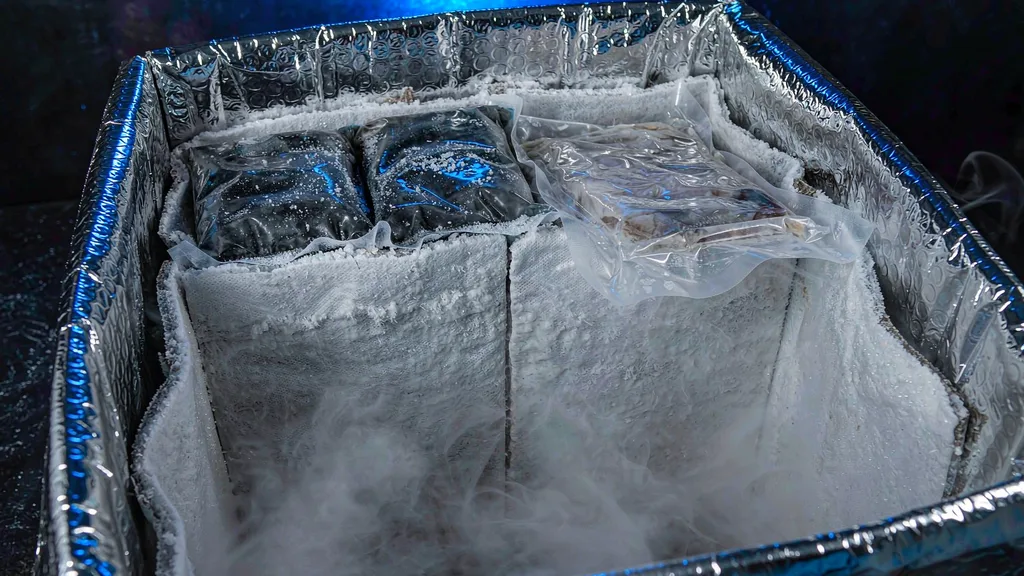
The core of cold-chain insulated packaging is not “the thicker, the better,” but a three-layer system where each layer plays its own role: EPE or bubble film acts as the insulation layer to block conductive heat, the foil-laminated layer reflects radiant heat, and phase-change ice packs supply cooling at the target temperature zone. Reverse-engineer the combination from “target temperature zone + hold time + ambient temperature” to hold 2–8℃ or ≤-18℃ for the required duration at the most reasonable cost.
How Heat “Leaks” In: Three Heat-Transfer Modes and How Packaging Counteracts Them
Insulated packaging design is essentially a layer-by-layer defense against three modes of heat transfer. Conduction travels through a material’s molecules and is intercepted by porous, low-conductivity materials—EPE pearl cotton has a thermal conductivity of about 0.033–0.038 W/(m·K), comparable to bubble film and far below the 0.2+ of solid plastics. Radiation comes from infrared heat off the sun and hot walls and is reflected by a low-emissivity surface—foil’s emissivity is below 0.05, bouncing most radiant heat back. Convection carries away cooling through air movement and is suppressed by a sealed structure—gaps at box joints, zippers, and seals drastically cut the insulation layer’s effectiveness.
GB/T 34399-2017 sets validation requirements for temperature-controlled facilities and equipment in pharmaceutical cold-chain logistics, and its thinking applies equally to food cold chains: no insulation solution should be judged by material parameters alone—actual temperature data must be the basis. This principle runs through all the selection logic below.
How to Choose the Insulation Layer: EPE, Bubble Laminate, and Foam Compared
| Material | Thermal Conductivity (approx.) | Characteristics & Use |
|---|---|---|
| EPE pearl cotton (30 mm) | 0.033–0.038 W/(m·K) | Mainstream choice; lightweight and compression-resistant; die-cut and moldable; moderate cost |
| Bubble-film laminated foil | 0.035–0.045 W/(m·K) | Combined insulation and reflection; foldable and recyclable; common for e-commerce fresh food |
| EPP foam insulated box | 0.030–0.035 W/(m·K) | High strength, reusable; pharma and premium fresh; higher unit price |
| Vacuum insulation panel (VIP) | 0.004–0.008 W/(m·K) | Extreme insulation but puncture-sensitive; deep-cold and high-value pharma scenarios |
Selection rule of thumb: for routine 24–48 hour delivery, 30 mm EPE or a bubble-foil composite liner is enough; for 72+ hours or hot summer regions, increase to 40–50 mm or switch to an EPP box; only consider VIP panels for pharma deep-cold transport. Increasing thickness from 30 mm to 40 mm raises thermal resistance by about one-third, but volume and freight rise in step—insulation performance and logistics cost must be calculated in the same table.
The Reflective Layer: Why Foil Laminate Is Indispensable
The insulation layer only slows conduction, not radiation. In summer, radiant heat from inside a vehicle or container top can account for over 20% of total heat load; the foil reflective layer is built for exactly this portion. Foil laminated with bubble film also adds moisture resistance and anti-condensation, preventing condensate from the ice-pack surface from soaking the outer box.
Pure foil or metallized film for the reflective layer? In thermal performance both have low enough emissivity; the difference is in barrier and mechanical properties: pure aluminum foil is completely impermeable to moisture and oxygen but creases and cracks easily; metallized film is flexible and low-cost but weaker barrier than pure foil. For products that need both flavor protection and moisture resistance (e.g., frozen goods, fermented milk), HASUPACK recommends a pure aluminum-foil laminate structure directly. For the specific differences, see High-Barrier Packaging Materials: Technical Comparison and Selection Guide—EVOH, Aluminum Foil, Metallized Film, and Transparent Barrier Coatings. If the contents are themselves freeze-resistant flexible pouches, also consider anti-friction between the foil liner and the product pouch—add a bubble bag as cushioning, following the protection approach in Air Column Bags and Inflatable Packaging: Lightweight Protection for Logistics Transport.
The Cold Source: Phase-Change Ice Packs by Target Temperature Zone
The key parameter of a phase-change material (PCM) is its phase-change temperature, not the “ice” itself. For 2–8℃ refrigerated goods, choose a coolant with a 0–4℃ phase-change point to avoid freezing vaccines and fresh milk; for frozen food, use ice packs or gel packs with a phase-change point below -18℃; for ultra-low-temperature biological samples, use dry ice (-78.5℃) or liquid nitrogen. Choosing the wrong phase-change point is the most common failure: using 0℃ ice packs for 2–8℃ pharmaceuticals, positions near the pack may drop below 0℃—labels compliant but substantively ineffective.
Quantities can be estimated from an empirical starting point: for 24-hour ambient delivery, ice-pack weight is about 20–30% of the contents’ weight; for summer environments above 35℃ or 48-hour hold times, raise to 30–50%. WHO TRS 961 Annex 9 provides a systematic validation framework for passive transport containers in vaccine cold chains, including hold-time confirmation under ambient temperature profiles (e.g., 35℃/43℃ profiles); food cold chains can borrow this method directly.
How to Estimate Hold Time: Calculate First, Then Test—No Guesswork
Engineering estimation uses a simplified heat-transfer formula: heat load Q = U×A×ΔT, where U is the overall heat-transfer coefficient (about 1.5–2.5 W/(m²·K) for a 30 mm EPE structure), A is the box surface area, and ΔT is the temperature difference between ambient and target. Taking a 20 L box, 30 mm EPE, 35℃ ambient holding 2–8℃ as an example: ΔT ≈ 25℃, Q ≈ 60–100 W, 48 hours requires 5–8 MJ of cooling, corresponding to 2–3 kg of 0℃ phase-change ice packs (latent heat of fusion ≈ 330 kJ/kg). Estimates must be calibrated by actual testing: test at full, half, and empty loads, and take the worst-case data as the promised hold time.
Three details in actual testing: place the temperature logger at the least favorable positions (against the box wall and against the ice pack); bumps on the actual transport route will change contact between ice packs and product; repeatedly opening the lid significantly shortens hold time—samples must match real delivery.
Compliance and Validation: Where Pharma and Food Differ
Pharmaceutical cold chains are bound by GSP and GB/T 34399-2017, requiring annual validation of boxes, ice packs, and routes, with traceable temperature data. Food cold chains have no equally stringent mandatory standard yet, but the Food Safety Law sets the principle that storage and transport must meet “temperature requirements that ensure food safety”; e-commerce platforms and supermarkets’ acceptance specs in fact follow pharmaceutical methods. HASUPACK’s recommendation: whether pharma or food, the validation logic is the same—first define the temperature range and hold time, then run a temperature-distribution test, and finally write the material, thickness, and ice-pack configuration into a written specification, so lead time and cost have a stable baseline. For the more complex temperature-humidity superposition in long-hold scenarios like ocean freight, see Why Flexible Packaging Fails in Export Container Shipping: Condensation, Stacking, and Temperature-Humidity Cycle Protection.
Frequently Asked Questions (FAQ)
How thick should the EPE be for cold-chain insulated packaging?
For routine 24–48 hour delivery, choose 30 mm; for hot summers or 48+ hours, choose 40–50 mm, or switch to an EPP box. Thickness determines conductive resistance but must be weighed together with ice-pack quantity and box volume—simply thickening alone does not mean overall compliance.
What is the difference between phase-change ice packs and ordinary ice packs?
Ordinary ice packs have a melting point of 0℃, and after melting the temperature can briefly drop below 0℃; phase-change ice packs set the phase-change point at target zones such as 2–8℃ or -18℃ by formulation, and the temperature stays stable near the phase-change point during melting, suitable for pharma and fresh goods sensitive to the temperature window.
How many ice packs does one box need?
The empirical starting point is 20–30% of the contents’ weight (24-hour ambient); raise to 30–50% in summer or for 48-hour holds. Precise quantities are estimated by the heat-transfer formula and calibrated by testing; test at both full and empty loads and take the worst-case data as the promised hold time.
Which is better, foil insulated bags or EPE insulated boxes?
They address different heat-transfer modes: foil blocks radiation, EPE blocks conduction; the correct answer is to use them together. A bubble-foil composite liner placed inside an EPE or paper-based outer structure gives a clear hold-time gain over either used alone.
What to watch for when shipping fresh food with dry ice?
Dry ice is at -78.5℃ and must not touch food directly—place it in a separate layer; sublimation produces CO₂, so the package must have vent holes to prevent bursting; air transport is restricted by dangerous-goods rules and must be declared and limited per airline requirements.
What validation does cold-chain insulated packaging require?
First define the target temperature zone and hold time, then run a temperature-distribution test: place sensors at least-favorable positions, run three rounds at full/half/empty loads, and test against the actual ambient temperature profile. Pharmaceutical cold chains must also perform annual validation per GB/T 34399-2017 and retain temperature-control data records.





