





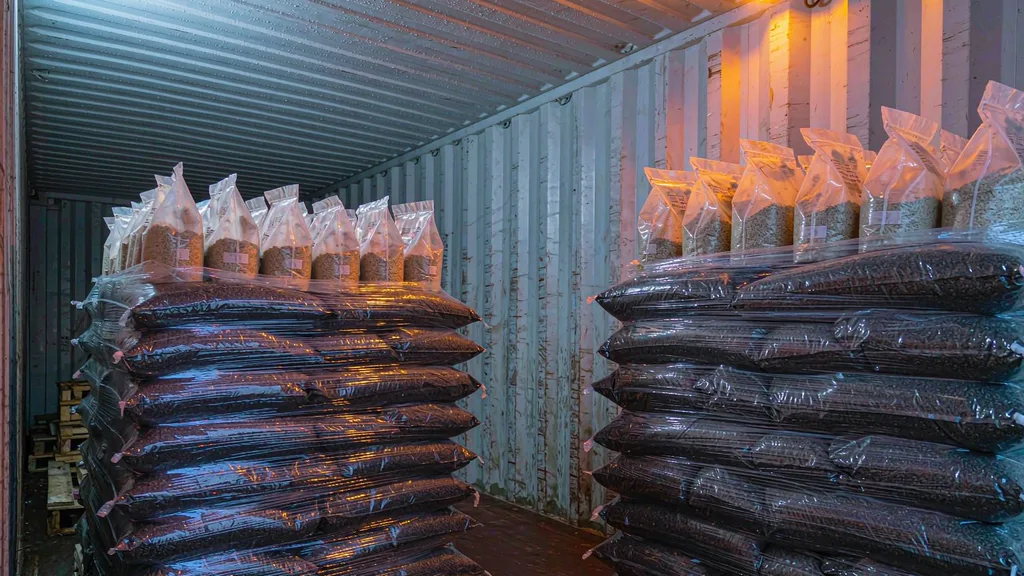
Export ocean shipping is the harshest environment in a flexible package life cycle: the day-night temperature swing inside a container can reach 15–20℃, water vapor condenses on the roof and drips as “container rain,” and palletized goods endure over ten days of vibration plus stacking pressure several meters high. A package that lasts 12 months on the shelf is not guaranteed to survive 30 days at sea. This article addresses the three failure sources condensation, thermal-humidity cycling, and stacking with protection combinations you can apply directly.
What Is “Container Rain” and Why It Is the Top Cause of Ocean-Shipping Damage?
Container rain is not real rain, but water vapor inside the box condensing on the metal roof and dripping. Its moisture sources are more numerous than most imagine:
- Moisture from the cargo itself: when wooden pallets, paper corner protectors, and cushioning have high moisture content, a 40-foot container can release several kilograms of water vapor into the box.
- Air inside the container: the air sealed in during loading already carries moisture; the day-night temperature swing makes it repeatedly condense on the roof, drip, and re-evaporate.
- Container leakage: on old containers, the door gasket ages and salt spray and rain slowly seep in during the voyage.
The industry quantifies container rain as: a single voyage can condense 1 to 2 liters or more, enough to collapse unprotected cartons, detach labels, and corrode metallized layers. For the flexible package itself, the dripping water acts directly on the carton and bag surface, and the problem often propagates inward from the outer box.
How Thermal-Humidity Cycles Damage Flexible Packaging: Three Specific Mechanisms
During ocean shipping, temperature changes are large in amplitude and high in frequency; the laminate exposes three weak points through repeated expansion and contraction:
- Amplified micro-leaks at the seal. Pinholes or weak seals at the edge do not leak at ambient temperature, but day-night cycles make the film and seal repeatedly stretch and contract, gradually opening micro-channels through which outside moisture keeps entering the bag.
- Barrier material drift. Hydrophilic barrier layers such as PA and EVOH absorb moisture in high humidity, raising both OTR and WVTR; a shelf life rated for dry conditions no longer holds on a humid voyage.
- Interaction between contents and package. In high humidity, water vapor released by the food inside condenses on the inner wall, causing powder caking and mildew-like corrosion spots on the metallized layer.
The most practical rule for whether a shipment needs reinforced protection is the route temperature swing: for cross-equator routes or winter departures from the Northern Hemisphere, if the in-container day-night swing exceeds 15℃, configure the reinforced plan.
Stacking and Compression: Pallet Configuration Directly Sets the Pouch Damage Rate
A pallet inside a container is typically stacked 1.2 to 1.8 m high, and on-deck containers add further pressure. Most bagged-goods damage is not from insufficient pouch strength but from stacking forces transmitted onto the pouches. Protection points include:
- Pallet load calculation: the bottom bag bears roughly the sum of all upper layers; at 5 layers of 30 kg each, the bottom pouch surface bears over 100 kg a real test for a stand-up pouch bottom and side seals.
- Corner guards and interlayer pads: add paper corner guards at the four pallet corners and corrugated pads between layers to spread local point pressure into surface pressure, significantly lowering pouch damage.
- Stretch-wrap fixation: wrapping the whole load prevents layer misalignment from voyage sway; misalignment friction is a common cause of seal abrasion.
- Do not force-fill the container: leave ventilation gaps between cargo and container walls to reduce compression and let air circulate, cutting local condensation.
How to Build the Protection Combo: A Three-Layer Plan of Desiccant, Moisture Film, and Barrier Bag
For moisture problems, the industry has formed a three-layer protection system from outside in, configured by cargo value and route risk:
| Protection Layer | Common Material | Function | Use Case |
|---|---|---|---|
| Layer 1: In-container dehumidification | Container-specific desiccant bar | Lowers absolute humidity in the box, reducing condensation | Standard for all ocean containers |
| Layer 2: Pallet enclosure | Stretch wrap plus moisture hood | Isolates dripping water from direct carton contact | Rainy season, cross-equator routes |
| Layer 3: Pouch barrier | High-barrier laminate, foil bag | Controls total moisture entering the contents | High-value, moisture-absorbing contents |
Desiccant quantity has a mature estimation method: typically 1 to 1.5 desiccant units per cubic meter of container space, increased for high-moisture wooden pallets or humid routes. Note that desiccant handles the container-space moisture, while in-bag moisture must be solved by the barrier material and content-moisture control the two cannot substitute for each other.
For products needing high barrier (freeze-dried food, powders, precision-metal accessory packaging), upgrade the pouch to an aluminum-foil or high-barrier transparent structure, and request the measured WVTR and OTR reports from the packaging factory at selection rather than judging by material name alone; for how to read OTR and WVTR figures and test conditions on those reports, see the HASUPACK guide How to Read OTR and WVTR: Interpreting Barrier Test Data and Selection. If the cargo includes precision metal parts, rust prevention matters alongside moisture protection; the logic of pairing desiccant with VCI film is in Rust Prevention for Precision Metal Export Packaging: VCI Film, Foil Barrier, and Desiccant.
Four Verifications Before Shipment
Whether the protection plan works can be largely verified before loading:
- Stacking test per GB/T 4857 series, simulating the compression on bottom bags under full-container stacking, observing whether seals and bottom seals deform or leak.
- Thermal-humidity cycle test, under 5–40℃ cycling with high humidity, examines seal micro-leaks and reproduces most ocean-shipping failures.
- Desiccant configuration review, checking the quantity by container type and route, and verifying the desiccant bars hang clear of direct dripping-water wash.
- Loading visual inspection: intact container gaskets, dry and odor-free interior, and qualified pallet moisture these three are zero-cost yet the most frequent sources of hidden risk.
Record the verification results in the outgoing inspection report; once damage occurs at port, these records are also key evidence for claims against the carrier or insurer.
FAQ: Common Questions on Export Ocean-Shipping Flexible Packaging
What is container rain and how does it form?
Container rain refers to the phenomenon of water vapor inside the box condensing on the metal roof and dripping. The moisture comes from water-bearing cargo materials, the air sealed in during loading, and slow leakage through the container; a single voyage can condense 1 to 2 liters or more, the main cause of collapsed cartons and fallen labels in ocean shipping.
Why does flexible packaging fail sooner at sea than its shelf life suggests?
Ocean shipping concentrates four stresses: high temperature and humidity, day-night thermal-humidity cycling, continuous vibration, and stacking static pressure. Micro-leaks at the seal are amplified by cyclic expansion and contraction; hydrophilic barrier materials absorb moisture and their WVTR rises; and a shelf life rated at ambient conditions visibly shrinks on a humid voyage.
How much desiccant should go in a container?
Typically configure 1 to 1.5 desiccant units per cubic meter of container space, increasing for high-moisture wooden pallets or humid cross-equator routes. Desiccant only lowers the humidity of the container space; in-bag moisture protection depends on the package own barrier layer.
How to prevent stacking damage to bagged goods?
Use corner guards and interlayer pads to spread point pressure into surface pressure, wrap the whole load to prevent misalignment friction, control stacking layers so the bottom bags load stays within pouch strength, and verify per GB/T 4857 stacking methods before shipment.
What shipping verifications are needed before export?
At minimum: stacking test, thermal-humidity cycle test, desiccant quantity review, and loading visual inspection. The verification records are also key evidence for claims against the carrier or insurer after damage.
How to strengthen protection for high-value, moisture-sensitive products at sea?
Adopt a three-layer plan: in-container desiccant bars, a pallet moisture hood, plus a high-barrier laminate for the pouch, and request the measured WVTR report of the barrier material; for freeze-dried or powdered contents, directly use an aluminum-foil barrier structure.





