





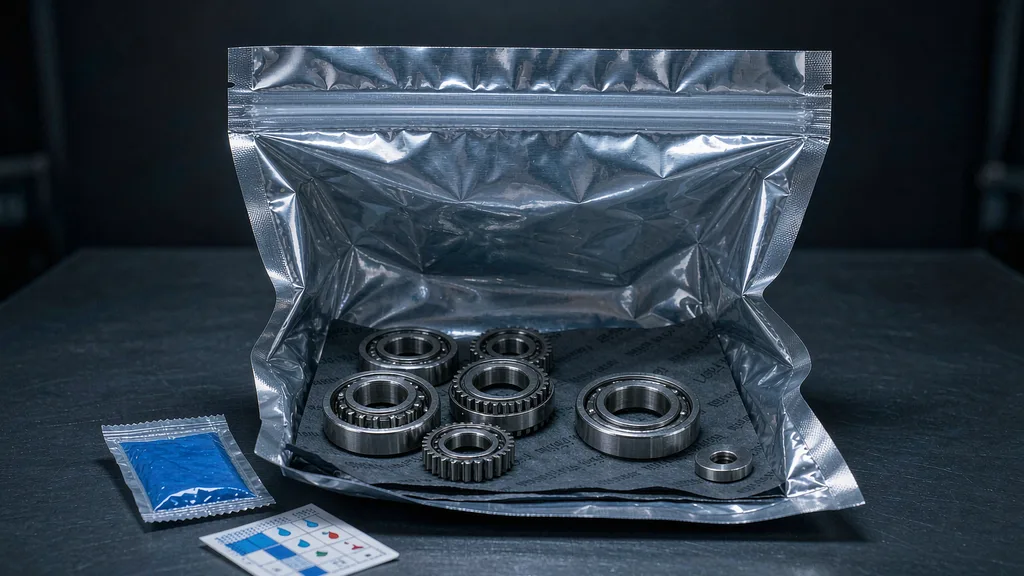
Anti-rust export packaging for precision metal parts is not a single-material problem but a combination of three lines of defense: VCI (volatile corrosion inhibitor) film handles “internal protection,” the aluminum-foil barrier pouch “blocks outside moisture,” and the desiccant “absorbs residual humidity.” The three lines are combined by product value, export cycle, and destination-climate; drop one, and the rust risk concentrates onto the remaining lines.
Why Metal Rusts: Condensation Is the Main Cause
Steel parts do not rust easily in clean, dry air; the real issue is the critical relative humidity—once ambient humidity exceeds roughly 60%, the water film formed on the metal surface is enough to support electrochemical corrosion, and the rust rate rises sharply with humidity. Ocean shipping systematically creates exactly this condition: large day-night temperature swings in the container cause the humid air drawn in by day to condense on the cold inner walls and cargo surfaces at night, cycling repeatedly over a 30-day voyage.
A more hidden contamination source is inside the factory: salts in hand sweat, cutting-fluid residue, and fingerprints all pull the critical humidity below 60%—a handled part stored in an apparently “qualified” warehouse will still start rusting from the fingerprint. So the first step in anti-rust packaging happens before bagging: cleaning and drying are process steps, not the packager’s responsibility, but the packaging solution must be built on the premise that this step is done thoroughly.
First Line of Defense: How VCI Film Works
The inhibitor in VCI packaging material volatilizes slowly, diffuses through the sealed space, and adsorbs onto the metal surface, forming a molecular-level protective film that neutralizes surface charge and blocks the electrochemical corrosion path. Its core advantage is “contactless protection”: for parts with complex shapes and blind holes where film cannot reach, the vapor can.
Three engineering points in use:
- Effective distance is limited. Inhibitor gas concentration decays with distance; generally keep the metal surface within 30 cm of the film, and beyond that add film interlayers or VCI paper inside the package.
- Keep the volume as small as possible. With the same inhibitor dose, a larger internal void lowers the concentration per volume and slows activation.
- Isolate from acidic and sulfur-containing materials. Certain woods and chlorine-containing packaging consume or interfere with the inhibitor; do not mix them in the same package.
GB/T 4879 (Rust-Preventive Packaging) systematically specifies the classification, protection period, and test methods for anti-rust packaging. Export parts are usually designed for a protection period of one year or more, and material selection and validation are benchmarked to this standard.
Second Line of Defense: Aluminum-Foil Barrier Pouch Blocks Outside Moisture
The primary issue in anti-rust is really moisture management. The aluminum-foil barrier laminate pouch is among the best moisture-barrier solutions in flexible packaging; a quality foil structure can achieve water vapor transmission below 0.1 g/m²·24h—a level pure PE pouches or ordinary metallized pouches cannot reach. For high-value precision parts, the foil pouch is almost the default choice; when selecting, the key is distinguishing pure-aluminum from metallized pouches and their thickness structure, as explained in our aluminum foil bag buying guide.
Don’t overlook the pinhole issue when choosing foil pouches: the thinner the foil, the higher the pinhole probability, and barrier performance drops off a cliff—which is why foil pouches need actual WVTR measurement rather than relying on nominal thickness. The interpretation of test data is covered in our guide to reading packaging barrier test data.
Third Line of Defense: How to Calculate Desiccant Dosage
Even with an excellent barrier pouch, the moisture in the trapped air at sealing and the moisture released by the packaging itself remain; the desiccant clears this “internal moisture.” Desiccant selection and dosage can follow the unit-desiccant system of DIN 55473; a common simplified engineering formula is:
Desiccant weight (g) ≈ (barrier-surface area × per-area dosage) + (compensation for porous contents)
Typically 20–50 g of silica gel per square meter of barrier surface, with the value set by the barrier layer’s WVTR and transport duration; add more for porous contents such as foam, paper inserts, or wooden pallets by their moisture content. Two operational disciplines:
- Place before sealing, do not open after sealing. The desiccant goes in at the final bagging stage and the pouch is sealed immediately; a desiccant exposed to workshop air for over half an hour has already consumed a substantial part of its capacity.
- Include a humidity indicator card. A color-changing humidity indicator card lets the receiver judge internal humidity without opening the pouch; in a dispute it is the only traceable evidence.
Configuration Recommendations by Export Cycle Tier
| Export scenario | Protection period | Recommended configuration |
|---|---|---|
| Near-ocean Asia, within 30 days | Short term | VCI film + thickened PE barrier pouch + standard desiccant dosage |
| Europe/US ocean freight, 45–60 days | Medium term | VCI film + aluminum-foil barrier pouch + standard desiccant dosage + humidity indicator card |
| Trans-ocean or seasonal ports, 90+ days | Long term | VCI film + double-layer aluminum-foil barrier + increased desiccant + container-hung drying pole |
The value of tiering is cost control: near-ocean parts need not carry the full long-haul configuration, and long-haul parts should not save on the barrier layer. Low-value loose accessories can be downgraded to VCI paper wrapping, but high-precision gauges and bearing products should not skip the foil barrier at any tier.
Process Discipline at the Bagging Stage
- Package immediately after cleaning. Do not leave cleaned parts overnight before anti-rust packaging; the day-night humidity swing in the workshop is enough to re-moisten the clean surface.
- Operate with gloves. Bare-hand contact is the most common root cause of rust complaints on finished parts; rust at fingerprint sites is almost impossible to explain to the customer.
- Seal width must be sufficient. Foil-pouch heat-seal width is generally not less than 10 mm; the seal must not entrap debris or wrinkles, and seal-quality spot checks should run at least once per shift.
- Vacuum is not mandatory. Anti-rust packaging focuses on humidity control, not negative pressure; unless the product has special requirements, a conventional seal plus desiccant suffices, and over-vacuuming can actually crush precision parts.
FAQ
Can you use only VCI film or only a desiccant?
Not recommended. The two protect by different mechanisms: the desiccant keeps in-pouch humidity below the critical level, while the VCI film forms a molecular protective layer on the metal against residual attack. With desiccant alone, if the barrier is breached or slow-release fails, the metal surface has no protection; with VCI alone and no humidity control, the inhibitor is consumed fast and the protection period shortens markedly.
Is more desiccant always better?
No. Excess desiccant adds no protection, only cost and package volume, and dust-generating desiccant packets can contaminate precision surfaces. Dosage is simply calculated from barrier-surface area, transport duration, and the moisture content of contents; the key is a short exposure time before sealing.
How to choose between an aluminum-foil pouch and a metallized pouch?
For high-value precision parts and long-haul exports, choose a pure aluminum-foil pouch—high and stable barrier performance. Metallized pouches rank lower in barrier but cost less, suiting short-cycle, mid-to-low-value parts. Distinction methods and common pitfalls are detailed in the aluminum foil bag buying guide.
What treatment is needed before bagging anti-rust packaging?
Cleaning is the prerequisite: remove cutting-fluid residue and salts, then package immediately after drying. Operators must wear gloves to avoid sweat-fingerprint contamination. The packaging solution is assumed to rest on this step being done properly; otherwise any material solution is compromised.
What standards can export anti-rust packaging rely on?
Domestically, GB/T 4879 (Rust-Preventive Packaging) is the benchmark, specifying protection-period grading and test methods; desiccant selection can reference the DIN 55473 unit-desiccant system; military-background orders may also involve specifications such as MIL-PRF-3420 for VCI packaging materials—align to the customer’s requirements.
Are additional moisture-control measures inside the container needed?
Recommended for long hauls. The repeated condensation from day-night container temperature swings acts on cartons and pallets alike; even with an intact pouch, moisture absorbed by outer packaging creates secondary dampness risk. A container-hung calcium-chloride drying pole is the most cost-effective supplement.
How to verify the anti-rust period?
Perform humidity testing by the GB/T 4879 method, combined with real transport tracking. At order intake you can require the packager to provide humidity-test reports for the same structure and material; during full production, spot-check seals and barrier by shift to build traceable quality records.





